
When Your Body Says MAX: Could SVT Be a Sign That Your System Has Reached Its Threshold?
What if an SVT episode isn’t just about your heart—but about your body’s overall capacity to regulate?
One of the biggest shifts in my own understanding of SVT came when I stopped looking at an episode as an isolated event happening to my heart and began looking at the bigger picture.
Because the heart doesn’t exist in isolation.
It is part of an incredibly interconnected system—your nervous system, digestive system, endocrine system, hydration status, mineral balance, sleep, stress response, breathing, emotions and so much more are constantly communicating with one another.
And sometimes, I believe, the body reaches a point where it simply says:
ENOUGH.
Or perhaps more accurately:
MAXIMUM CAPACITY REACHED.
I think of this as the MAX response.
Not because SVT is simply “caused by stress” or because every person with SVT has the same underlying imbalance. SVT is a real electrical rhythm disturbance in the heart, and it can occur for a variety of reasons. But we also know that certain conditions—including emotional stress and changes in electrolytes—can influence the cardiovascular system and may increase the likelihood of abnormal rhythms in susceptible people.
So what if, for some of us, an SVT episode represents the moment when multiple layers of stress on the system converge?
Not necessarily one giant problem.
But a perfect storm.
The Perfect Storm
Think about everything your body is managing on any given day.
You didn’t sleep well.
You’re dehydrated.
You’ve been running on coffee.
You’ve been under emotional stress.
You’ve eaten more than your body comfortably wants to process—or you unknowingly consumed a food allergen.
Your digestion isn’t moving well.
You’re not absorbing or replenishing nutrients optimally.
You’re carrying tension in your body.
You’ve been sitting all day and haven’t moved your lymphatic system.
Your nervous system has been in high alert or in a protective response.
You’re rushing.
You’re overstimulated and stretched too thin.
You’re holding your breath.
You’re not giving yourself enough time to recover.
None of these things necessarily means that an SVT episode is going to happen.
But what if they can collectively move your body closer to its threshold?
Imagine a glass slowly filling with water.
One stressor adds a drop.
Then another.
And another.
You may not notice anything happening for a while.
Until suddenly—
the glass overflows.
The final drop didn’t necessarily cause the overflow.
It was simply the drop that arrived when there was no more room.
That is the way I think about the MAX response.
Your Body Is Always Responding to Its Environment
Your body is constantly taking in information from its environment.
And “environment” isn’t just the world outside of you—the things we cannot control.
It’s also the environment inside of you—the things within your control.
What are you eating?
How well are you digesting?
Are you hydrated?
Are you getting enough sleep?
Are you replenishing minerals?
Are you living in a constant state of urgency?
Are you breathing deeply?
Are you moving your body?
Are you giving your nervous system opportunities to come back down?
Are you processing emotions—or constantly overriding them?
Are you asking your body to perform when it is asking for rest?
These are not separate systems.
They are part of one beautifully interconnected organism.
And your heart is listening.
The Nervous System Matters
This is one reason I became so interested in the nervous system and the vagus nerve.
The vagus nerve is an important part of the parasympathetic nervous system and is involved in communication between the brain, heart and digestive system. Vagal maneuvers are also an established acute treatment for certain types of SVT because they can influence the heart’s electrical conduction through the AV node.
That doesn’t necessarily mean that “vagus nerve dysfunction causes SVT.”
It means something much more interesting to me:
The nervous system has a relationship with the heart.
And that relationship gives us something to work with.
Instead of waiting until the body reaches MAXIMUM capacity, what if we spent more time helping the body experience regulation & resilience throughout the day?
Not perfectly.
Just consistently.
A few minutes of slow breathing.
A walk.
Stretching.
Resting.
Gentle movement.
Time outside.
Eating mineral-rich foods.
Creating space between activities and learning the skill of saying NO.
Getting enough sleep, trying to go to bed at the same time every night and creating good sleep hygiene habits.
Learning to recognize when you’re moving into sympathetic overdrive.
Learning how to come back down and practice self-care.
Layering in soothing practices like daily journaling and meditation.
These seemingly small practices may not feel particularly dramatic.
But perhaps that’s the point.
We don’t necessarily need dramatic interventions when we’re practicing regulation every day.
Your Daily SVT Support Practices
This is also why I don’t believe that managing SVT should be reduced to what you do during an episode.
There is an entire conversation that can happen around what you do between episodes.
Because between episodes is where you have an opportunity to build capacity and support your body.
For me, that means looking at the foundations, here are a few to start with:
Hydration
Adequate hydration supports normal cardiovascular function, and dehydration can be one piece of the physiological stress picture.
Hydration isn’t a magic cure for SVT—but it is one of the basic ways we support the body.
Minerals
Your heart depends on electrical signaling, and electrolytes—including potassium, sodium, calcium and magnesium—play important roles in that process. Significant electrolyte disturbances can interfere with normal cardiac signaling.
This is one reason I believe it is worth paying attention to the quality of your diet and discussing persistent concerns about nutrients or electrolyte balance with a qualified healthcare professional rather than simply assuming that more supplementation is better.
Food and Digestion
Food is another piece of the picture.
Digestion is a significant physiological process—and the vagus nerve is deeply involved in the regulation of digestion.
For some people, large meals, digestive discomfort, reflux, bloating or certain foods may seem to coincide with episodes.
What happens when you eat too much?
What happens when you eat too quickly?
What happens when you’re already stressed and then have a large meal?
What foods leave you feeling inflamed, uncomfortable or depleted?
Your body is giving you information, and this is a vast topic that you can learn much more about.
Browse my SVT Prevention Diet e-guide HERE
Sleep
Sleep is not a luxury.
It is one of the body’s primary opportunities for restoration and regulation. Poor sleep can place additional stress on the cardiovascular and nervous systems, which is one reason sleep belongs in the conversation when we’re looking at the overall SVT picture.
Nervous System Regulation
You cannot tell your nervous system to “calm down” while continuing to live as though everything is an emergency.
There are ways to assist our nervous system to respond to our environment, especially when the daily environment feels more and more stressful, demanding, busy and fast-paced than ever before.
Intentional, healthy regulation has to become a practice—and there are a lot of options to choose from.
Some of them are:
Breathwork.
Daily walks.
Stretching and/or a slow Hatha-style yoga practice.
Resting. No need to force sleep or naps. Just closing your eyes and resting. Maybe in a rocking chair or with a lavender sleep pillow over your eyes or a heating pad on your belly. Anything that feels restorative and soothing.
Creating boundaries and leaning into all the many types of self-care.
Reducing stimulation.
Spending time in nature. Lately, I love swimming.
Laughing.
Connecting. Specifically inwardly, with yourself, and even your inner child.
Doing things that make you feel safe in your body. Maybe even using tools to assist with this, like a weighted blanket, stuffed animal, or weighted vest.
And journaling.
Journaling can be such a simple way to begin releasing some of the things we carry around internally.
Sometimes our minds are working overtime because there is simply too much being held inside.
Thoughts.
Worries.
Emotions.
To-do lists.
Things we haven’t said.
Things we haven’t processed.
Things we don’t even realize we’re carrying.
Putting those things onto paper can create a little more space.
It gives us an opportunity to pause, listen inwardly, process what we’re feeling and consciously release some of the mental and emotional burden we’re carrying.
You don’t have to solve anything in your journal.
You don’t have to make sense of it.
You can simply let it out.
Sometimes that alone can be a form of self-care.
These practices aren’t indulgences.
They’re necessary signals we are sending to our bodies—input to help us calm down. To signal to our bodies that we are safe.
I’m safe.
I can slow down.
I don’t have to be “on” all the time.
Raise the Threshold
This is ultimately the idea I want you to take away.
I’m less interested in teaching you to become terrified of every possible SVT trigger.
Because that can create another problem:
hypervigilance. (And constantly monitoring your heart can itself become stressful.)
Instead, I want you to think about raising your threshold.
What can you do every day that helps your body become more resilient?
Can you sleep a little better?
Can you hydrate consistently?
Can you eat foods that genuinely nourish you?
Can you identify foods that don’t agree with you?
Can you move your body in ways that really feel good?
Can you use healthy release methods like journaling?
Can you create more space in your day for self-care?
Can you learn to recognize the signs that you’re becoming overwhelmed before you reach the edge?
Can you give your nervous system opportunities to come back into balance?
Can you take care of your body before it has to ask loudly?
Because perhaps the goal isn’t simply:
“How do I stop SVT?”
Perhaps the deeper question is:
“How do I create a body that has more capacity to regulate?”
That is a very different question.
And it gives us a very different path forward.
Your Body Isn’t Betraying You
I know how frightening SVT can be.
When your heart suddenly begins racing, it can feel as though your body has turned against you.
But I’ve come to see the body differently.
The body is constantly trying to communicate.
It is adapting.
Compensating.
Responding.
Protecting.
And sometimes, when enough systems are under strain, the message becomes impossible to ignore.
MAXIMUM CAPACITY.
It doesn’t mean that regulating your nervous system, changing your diet or taking better care of yourself will guarantee that you never experience another episode. It just means that there is value in looking beyond the moment your heart begins to race.
Instead of asking only:
“What caused this episode?”
we can begin asking:
“What was happening in my whole body before I reached my threshold? and “What is within my control that could help support myself in deeper more nurturing ways?”
These questions open up a much bigger conversation.
A conversation about nourishment.
Hydration.
Minerals.
Digestion.
Sleep.
Stress & self-care.
Movement.
Breath.
The nervous system.
Emotions & regulation practices.
And the daily practices that help us create more capacity, resilience and regulation.
Because sometimes healing begins not with waiting for the body to scream—
but with learning to listen while it is still whispering.
A Note From My Approach
This is the foundation of the integrative approach I call Heal SVT Naturally.
I don’t believe in chasing one magical trigger or one magical cure.
I believe in viewing SVT from an integrative lens.
Looking for patterns.
Reducing the cumulative load on the body.
Supporting the systems that help us regulate.
And learning to listen to the signals our bodies are giving us—long before they reach MAX.
Your body is not your enemy.
It has been communicating with you all along.
The question is:
How can we listen, how can we develop a nurturing relationship with ourselves, how can we assist our bodies, how can we raise our SVT threshold?
Want to Go Deeper?
If this article resonated with you, I invite you to take the next step in understanding your own SVT.
Start With My FREE Guide
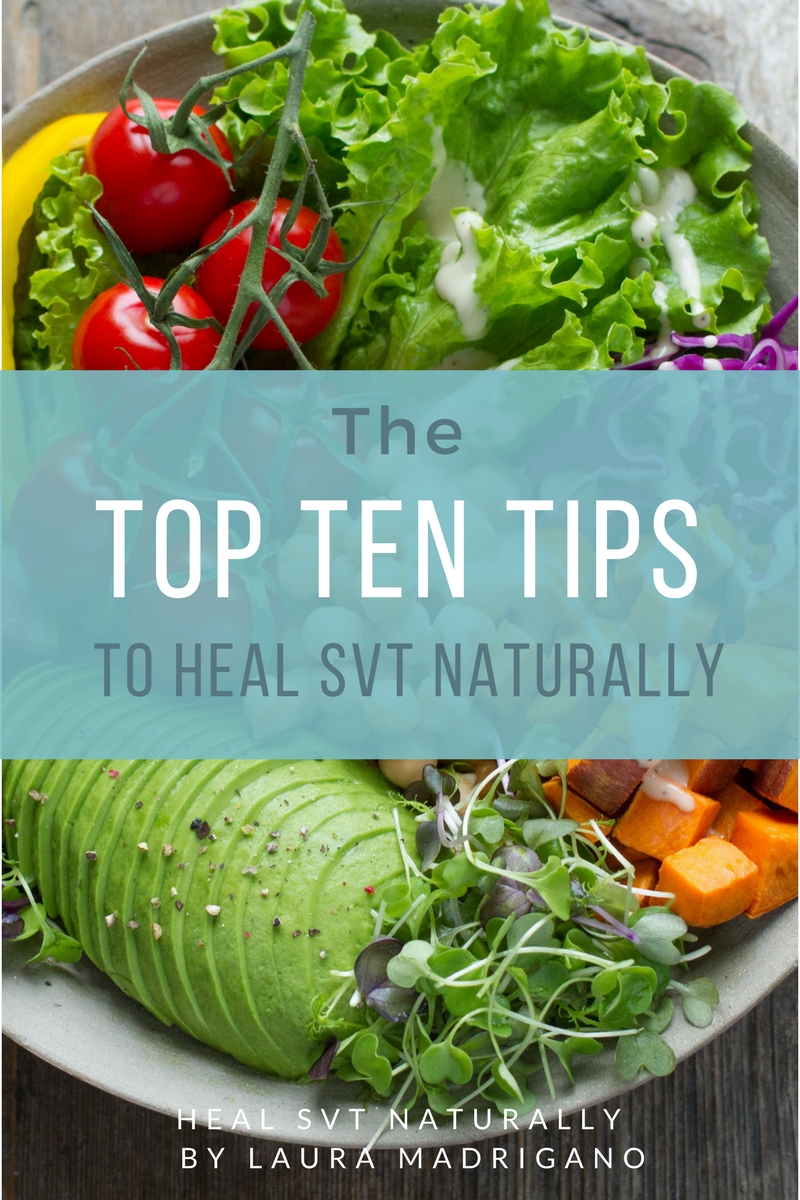
The TOP 10 TIPS to Heal SVT Naturally
Inside, I share practical things you can begin exploring to support your body, understand your own patterns and triggers, and create a stronger foundation for healing.
[CLICK HERE to get your FREE copy →]
Want to Understand Your SVT From a Root-Cause Perspective?
If you’re ready to go deeper, I also offer one-on-one coaching for those who want to explore their SVT from an integrative, root-cause perspective.
Together, we can look beyond the episode itself and explore the patterns, triggers, lifestyle factors, nervous system, nourishment, digestion, stress and other areas of your life that may be contributing to your overall physiological load.
[CLICK HERE to learn about working with me →]
And Don’t Underestimate the Power of Your Journal
One of the simplest tools you can begin using today is a journal.
You don’t need to have all the answers.
You don’t need to know exactly what you’re feeling.
You can simply begin by asking:
What am I carrying today?
What does my body want me to know?
What can I release?
What do I need more of right now?
Sometimes the things we’re carrying aren’t physical at all—but the body still has to carry them.
Journaling gives us a place to put them down.
If you’d like to explore journaling as a way to reconnect with your own inner wisdom, you can also explore my guide:
Journaling With Your Intuition: A Guide to Help You Reconnect with the Wisdom of Your Soul.
[CLICK HERE to explore Journaling With Your Intuition →]
Heal SVT Naturally is an educational and coaching resource and is not a substitute for medical diagnosis or treatment. If you experience symptoms of SVT or another heart rhythm disorder, please seek appropriate medical care.

Recent Comments